That Cough and Throat-Clearing That Won't Quit Isn't Allergies — It's a Hidden Enzyme Most Doctors Never Check For
For years they told me it was allergies, anxiety, or a sinus drip, but it wasn't any of those. The life's work of a New York throat doctor finally explained what was burning my throat. And it led me to the simple daily thing that gave me back my coffee, my food, and my voice.

Published
This is a personal story shared to help others. It's not medical advice. Please talk to your own doctor about your health.

My name is Karen, and after 22 years teaching fourth grade I figured I had life mostly worked out by the time I hit 54. But for almost six years there was one thing I could not work out, not for myself and not with any doctor. Little by little, it had me convinced I was losing my mind. I'm writing all of this down so you don't lose another year the way I did. And if your throat has been a problem for a long time and no one can tell you why, the day I finally learned what it was changed everything.
Do any of these sound like your day.
You wake up and the first thing you do is clear your throat. Then you do it again. There's thick mucus sitting at the back of your throat that won't come up and won't go down. Your voice is rough and croaky for the first hour you're awake. You have a dry, tickly cough that comes out of nowhere and won't stop. And there's that feeling, the worst one, like there's a lump stuck in your throat that you keep trying to swallow away.
And here's the strange part. Through all of it, there's no heartburn and no burning in your chest at all. And because heartburn is the one sign everybody ties to reflux, reflux ends up being the very last thing anyone thinks to check, not your doctor, and not you.
That was me, every single morning. I was never sick enough to stay home in bed, but I never felt well either. I just felt a little off, all day, every day, and it went on like that for years.
Before I go any further, you should know I'm not a doctor or a scientist, just an ordinary woman who went through all of this myself. But everything I'm about to share with you comes from published research and from the doctors who have spent their lives studying this.
What Those Years Actually Felt Like
It helps to finally say all of it out loud, and maybe it helps you to know that someone else has lived it too.
The mucus was driving me insane, and that's the only way I can put it. I was clearing my throat so often that my husband started to wince every time I did it. In a quiet room, in church, in a meeting, at the dinner table, that little throat-clear sound, over and over, and I was so embarrassed.

My voice was the worst part for a teacher, and by the afternoon I was always hoarse. Some days it felt like I was swallowing razor blades just to get through a glass of water. There were mornings the lump was so bad I could barely drink anything at all.
And slowly, my life got smaller. I gave up my morning coffee because it made everything worse. I stopped eating at my favorite restaurant because I never knew how my throat would react. I missed having a glass of wine with friends. I missed coffee with my sister on a Saturday. Little by little I just stopped doing the things I loved, because every one of them came with a price.
I stopped sleeping through the night, waking up coughing, or waking up with my throat raw and my voice gone. After a while I felt alone with it. Nobody could see anything wrong, so to everyone around me I looked fine, but inside I was scared.
And then there was the thought that crept in at three in the morning, after years of coughing that no one could explain. Is this cancer. I typed those words into Google more times than I want to admit.
Five Doctors. Zero Answers.
So I did what you're supposed to do. I went to every doctor I could find.
My family doctor said it was allergies and gave me allergy pills. I took them for months, but nothing changed.
I went to an allergy specialist, and they ran their tests. They said I had some mild allergies and gave me a nose spray and an inhaler, but the cough stayed exactly the same.
I went to an ear, nose and throat specialist, the kind of doctor who looks deep in your throat with a little camera on a tube. He looked, he said he saw some irritation, and he told me it was probably a sinus drip down the back of my throat. He suggested I try to relax. One doctor actually told me it might be anxiety, that I was doing it to myself.

I went to five different doctors, and not one of them could tell me what was wrong. You can't imagine how horrible that feels. You go to appointment after appointment for years and walk out every single time with nothing but another inhaler or another allergy pill. All for a problem no one could even name.
And it was. They were just looking in the wrong place.
The Night Everything Changed
The thing that finally cracked it open for me was a comment on an online forum at one in the morning.
A woman had written about the exact same things I had, the cough and the mucus and the lump and the hoarse voice, and no heartburn either. Then she wrote one line that stopped me cold. She said, "If your reflux doesn't respond to the acid pills, the allergy pills, or the diet, then maybe it's not what they told you it is."

I sat up in bed. Reflux made no sense to me at all. I had never once had heartburn in my whole life, so how could that possibly be the thing that was wrong with me.
That one question sent me searching, late into that night and then for days, until I found the published work of a throat doctor I had never heard of. I read what she had spent her life proving, the piece of the puzzle my five doctors had never once mentioned. And I actually cried, because for the first time in years every symptom I had finally fit.
The doctor behind that work is Dr. Jamie Koufman, and she is one of the world's leading authorities on reflux. She gave her whole career to this one problem, long before anyone else was paying attention, and she was the first to truly see it for what it was. She calls it silent reflux.
It's called silent because it doesn't come with the one warning sign everyone knows to look for, which is heartburn. Instead it stays quiet and shows up as throat and voice and breathing problems. So for years it gets brushed off as allergies, or a sinus problem, or a nervous little cough.
And here is the part that made me furious once the pieces fell into place. Dr. Koufman uncovered what everyone else had missed. She found that the thing damaging the throat was never the acid itself. Something else was quietly eating away at my throat, something no acid pill could ever reach. But there is a catch. Her answer is simple and cheap, with no patented drug to sell, so the big drug companies had no reason to spread the word. A cure nobody can get rich from is an easy one to keep quiet.
That is why it stays buried, and why almost nobody hears it. I never did, not from a single one of my five doctors. So let me hand you what took me months to find.
What's Actually Happening in Your Throat
Your stomach makes digestive juices to break down the food you eat. Part of those juices is a tiny worker called pepsin. Pepsin is an enzyme, which just means it's a little tool your body makes to chop food into pieces small enough to digest. It belongs in your stomach, and nowhere else.
Now, your stomach has a thick, tough, built-in lining that protects it from its own juices. Think of it like a raincoat on the inside of your stomach. Acid and pepsin sit in there all day and the stomach is perfectly fine.
Your throat and your voice box have no such raincoat at all, which means the skin inside your throat is bare and soft and completely unshielded.
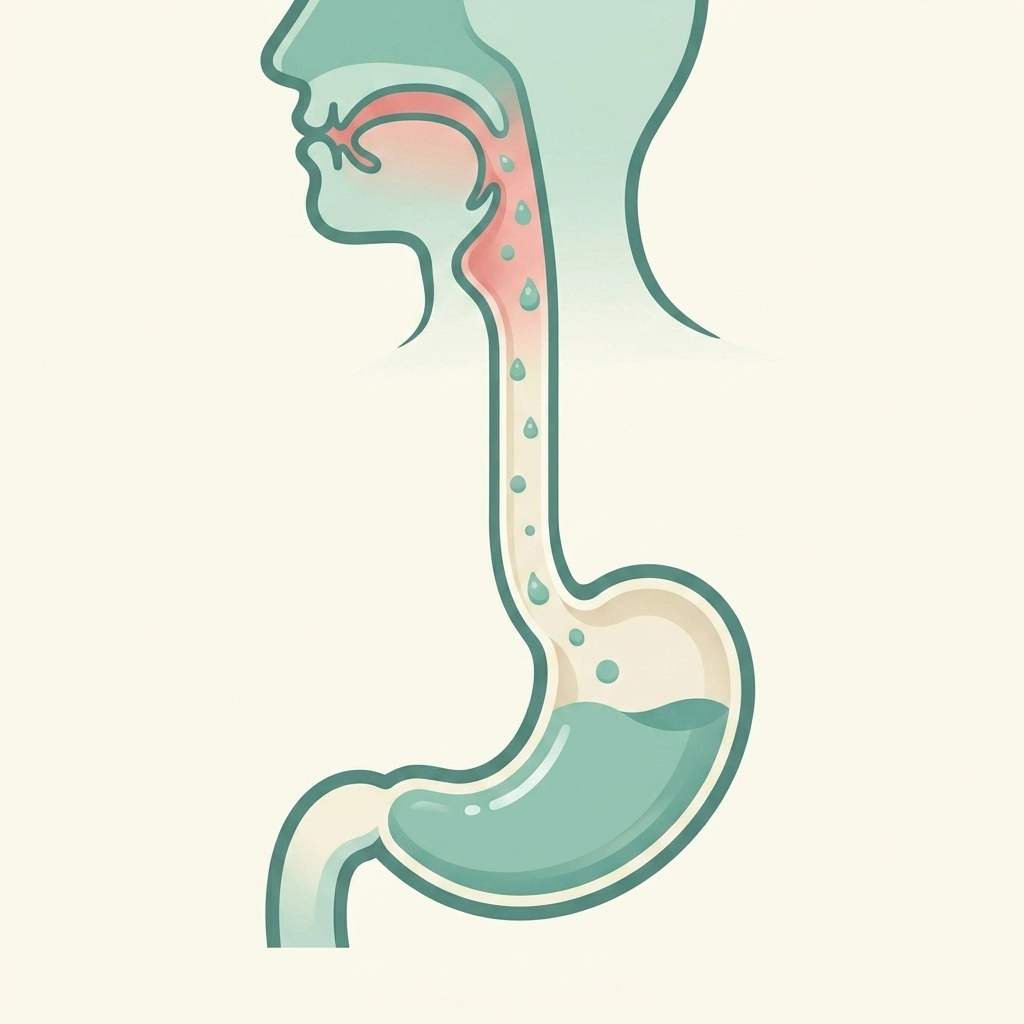
So here's the problem. When a small amount of those juices escapes upward, it carries pepsin with it, and that pepsin lands on the bare, unprotected skin of your throat. And pepsin doesn't just wash away, it sticks to that raw tissue and sits there waiting, because nothing up in your throat can break it down. So every time you eat or drink something acidic, like a coffee or a soda or a glass of juice, that leftover pepsin springs back to life. It starts chewing on your throat lining all over again. And every time you bend over or lie down at night, a little more pepsin gets up there. The same raw spot gets hit over and over.
That's why everything you feel is up in your throat and not down in your chest. The cough, the mucus, the lump, the hoarse voice. All of it is just your throat reacting to being hit again and again by something that was never supposed to be there.
And it's exactly why you don't get heartburn. The damage isn't happening down in your chest where heartburn lives, it's happening higher up in your throat, quietly, and that's the whole reason they call it silent.
Why It Gets Missed — Silent Reflux Hides Where Doctors Are Not Looking
Based on Dr. Jamie Koufman's research, 899 patients (published in the medical literature on laryngopharyngeal reflux)
Look at that for a second, because four out of five people with silent reflux never feel the one sign every doctor is trained to look for. No wonder it gets missed, and no wonder it got missed in you.
Why Nothing You Tried Ever Worked
Now you can finally see why nothing worked, and why none of it was ever your fault. This was never an acid problem, it was a pepsin problem, and every tool you were handed was built for the wrong one.
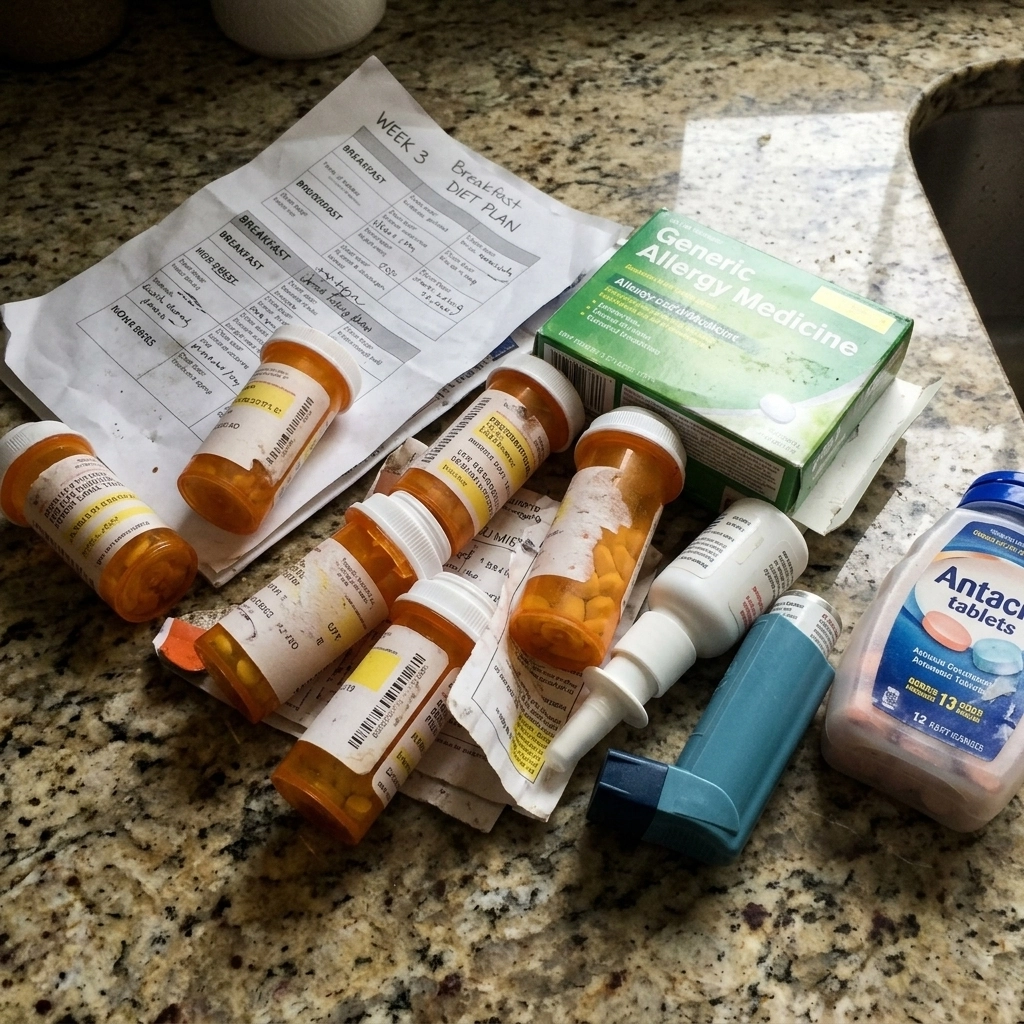
The acid pills. These are drugs like omeprazole and Nexium. Doctors hand them out for anything that smells like reflux. Here's all they do. They turn down how much acid your stomach makes, and that's it, because they do nothing at all to the pepsin. So even on the pills, the pepsin is still getting up to your throat and still sticking to that bare skin and still doing damage. You lowered the acid, but the troublemaker itself was never touched. That's why so many people say the same thing. The acid pills didn't fix it.
And there's a nasty trap inside those pills. When you've been on omeprazole or Nexium for a while and you try to stop, your stomach often fires back with even more acid than before. Doctors call this rebound. It feels like your problem came roaring back, so you panic and start the pills again, and now you feel hooked. The drug created the very thing that keeps you taking the drug.
The allergy pills and the nose sprays. These are made to fight allergies, but you don't have an allergy. What you have is a stomach enzyme sitting on the bare skin of your throat, so of course they never did a thing for you.
The strict diet. This one is closer to right, and it can help calm things down. Cutting out the acidic foods and not eating late means less pepsin gets stirred up to your throat. A lot of people try it, but here's the honest problem. A diet is slow and brutally hard to keep up. And even when you stick to it, it still can't do the one thing your throat is begging for. It can't soothe that raw, bare tissue and give it the chance to heal. I followed a very strict diet for weeks, but I was still struggling.
None of these were ever going to work, because not one of them was built for a pepsin problem.
It Used to Be Rare. Not Anymore.
One last thing helped me stop blaming myself.
Not that long ago this was rare, but reflux of this kind has nearly doubled since 1990. In a single generation it went from something uncommon to something almost everyone seems to have.

There are a few simple reasons for it. We eat far more processed and acidic food than people did 40 years ago. We eat late at night, then lie down, which is the perfect way to send those juices up. And there's one more strange piece. There used to be a common stomach germ called H. pylori that, oddly, helped keep stomach acid in check for a lot of people. Over the last few decades it has become far less common, and acid problems climbed.
So this is not some personal failing. Modern life manufactured this condition, and you walked straight into a trap the world set for you. That's worth knowing, because it means the fix is not about willpower. It's about giving your throat the protection the modern world stopped giving it.
The Three Things Your Throat Actually Needs
So if the acid pills miss it, and the allergy pills miss it, and the diet alone is not enough, what actually does the job.
Once you understand the actual problem, the answer becomes almost obvious. Your throat needs three things, all at once.
Coat & Soothe It
Lay a gentle, soothing coat over the raw, irritated throat, like balm over a scrape, so it stops stinging every time you swallow.
Calm the Inflammation
Cool the redness and swelling underneath that keeps the tissue angry and raw, so it can finally settle down.
Help It Heal
Feed the throat lining the nutrients it needs to repair itself and grow strong again.
Coat it. Calm it. Heal it. That's the whole game, and it was never about less acid. It's about soothing the burn, calming the inflammation underneath, and giving that raw tissue everything it needs to finally heal.
The Daily Liquid I Finally Found
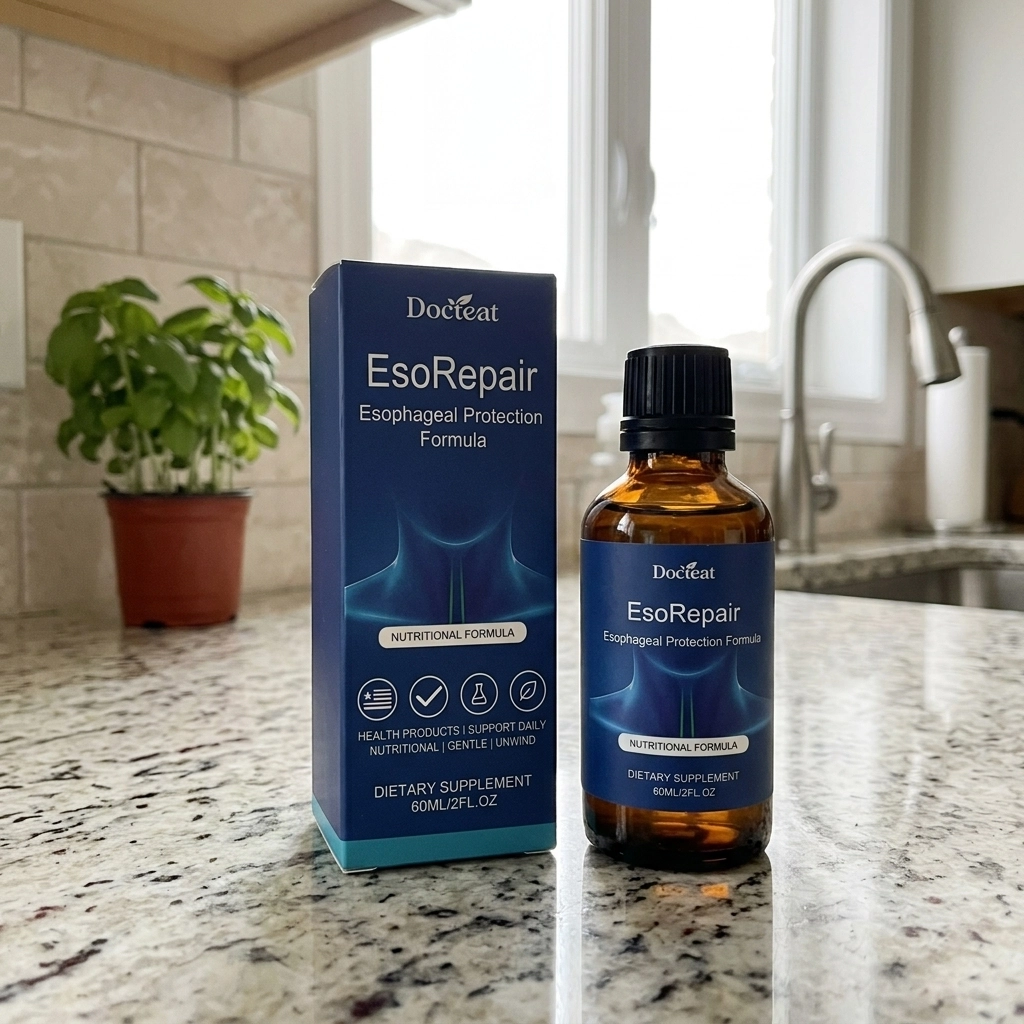
When I understood those three jobs, I stopped looking for a miracle and started looking for one simple thing that did all three at once. Most of what I found did only one. Some soothed the throat but did nothing for the inflammation underneath. Some fought the inflammation but did nothing to help the tissue heal. I wanted all three in one daily liquid, taken after meals and before bed, without choking down a fistful of pills. The one I settled on is called EsoRepair, and it does all three. It coats, it calms, and it helps the throat heal, all in a single daily dropper.
Here's exactly what's inside it, and what each piece does. This is the formula I went looking for and could not find anywhere.
First, it coats and soothes the raw throat.
- Aloe Vera Leaf Extract — the same cooling plant gel people put on a sunburn. Taken as a liquid, it spreads a soft, soothing coat over the raw, irritated throat. It is the biggest single ingredient in the formula.
- Licorice Root Extract — a root used for hundreds of years to calm a sore, irritated gut and throat. It soothes the tender tissue and helps it hold up.
Then it calms the inflammation underneath.
- Turmeric Root Extract — a golden root long used to quiet swelling and irritation in the body.
- Grape Seed Extract — a plant compound full of antioxidants that help calm redness and swelling.
And it feeds the throat what it needs to heal.
- Vitamin C — your body uses it to build and repair healthy tissue.
- Vitamin E — an antioxidant that protects the delicate lining while it mends.
- Vitamin B6 — helps your body use the building blocks it needs to repair itself.
Here's the proof that these ingredients hold up. In a published trial, researchers gave aloe vera to people with reflux for a month and put it head to head against the two most common reflux drugs, omeprazole and ranitidine. The aloe calmed their reflux symptoms just as well as the drugs did, and it did it gently, without the side effects. Aloe is the biggest single ingredient in EsoRepair, working right alongside licorice, turmeric, and grape seed to soothe, calm, and heal a throat that has been raw for far too long.
The throat specialists who truly understand silent reflux quietly point people toward exactly this kind of thing, soothing plant extracts plus the nutrients a raw throat needs to heal. Often they use it to help people ease off the acid pills. It is the approach that works, finally put into one daily liquid.
And there's one more thing worth knowing. Most throat products only do one job. A lozenge or a warm tea might soothe the burn for an hour, but it does nothing for the inflammation underneath and nothing to help the tissue heal. EsoRepair does all three at once, coat, calm, and heal, in one daily dropper. That is why, honestly, it is the most complete thing I have ever found for a throat like mine.
I Was Not the Only One
I know how it feels to read one person's story and wonder whether it could ever be yours, so here are a few others who lived it too.
"Honestly, I'd given up. I tried the acid pills, I tried cutting out coffee, and none of it touched the throat clearing. Thirty years as a nurse and I still couldn't work out what was wrong with me. My husband had even started counting how many times I cleared my throat in a day. I almost didn't order this, because I figured it was one more thing that wouldn't work. Two weeks in, the clearing calmed right down, and I slept through the night without waking up to cough for the first time in about two years."
"I'm on the phone all day for work, and my doctor had me on Nexium for years for a cough and a raspy voice that never went away. Honestly I was scared to come off it. I started taking this every day and tapered down slowly with my doctor's help, and the cough I'd had forever dropped by about half in the first couple of weeks. I just wish I'd found it sooner."
"I sing in my church choir, so losing my voice hit me hard. I'd been croaky and rough every single morning for years and I'd just learned to live with it. I was worried it would taste awful like some of the other things I'd tried, but it's actually easy to take. After a few weeks I woke up one morning and could sing all the way through the service again, and I sat in my kitchen and cried."
And one woman put into words what I think every one of us feels. She said it was the only thing that worked when the pills had failed, and that was my experience too. After almost six years, the mucus that had been driving me insane finally started to loosen its grip, the lump in my throat eased, and my cough slowly quieted down. The full healing took a few months of giving my throat that daily protection. But I started feeling the difference long before that, and the fear I had carried for so long finally turned to hope.

What It Feels Like to Get It Back
Picture waking up tomorrow and the first thing you do is not clear your throat. Picture pouring a cup of coffee in the morning and actually drinking it, slow, the way you used to.
Picture sitting down at your favorite restaurant and ordering the thing you love. Picture talking all the way through a phone call without your voice giving out. Picture a whole night of sleep, and waking up with a throat that feels like a throat and not like sandpaper.
Picture going a whole day and realizing, somewhere in the afternoon, that you haven't thought about your throat once. That's what getting your life back actually feels like, and it isn't some miracle, it's just your normal, ordinary, wonderful life, handed back to you.
What Another Year of This Costs
I have to be honest about the other side of this too, because I wish someone had been honest with me. This is not the kind of thing that fixes itself. A raw, irritated throat does not just heal on its own. For as long as the pepsin keeps landing on that same raw spot, the cough and the mucus and the rough mornings just carry on. The years slip by the way they did for me, one wasted appointment at a time. And the quiet worry I used to type into Google at three in the morning does not get any quieter by ignoring it. The damage would only keep building until something finally soothed and healed the one part of me that no one else was helping.
Here's Where to Start
If you've read this far, it's probably because so much of this already felt familiar. You may have spent a long time sensing that something was wrong, even when nobody around you believed it. The difference now is that you know what it is. It's silent reflux. It's pepsin reaching a throat that was never built to handle it. And you know what your throat actually needs, which is to be coated, calmed, and helped to heal every day.
The hardest part is already behind you, because you finally found the answer the whole system never gave you. All that's left for you to do now is start.
And this is the opposite of those acid pills that quietly hook you for life. You take EsoRepair to heal the throat, not to mask it. So as that raw, bare tissue finally gets soothed and starts to mend, you lean on it less and less, not more. It's something you use to get better and move on from, not another pill you stay chained to forever.
I held off for years because I was scared of being let down one more time, so I understand if you feel the same. That's exactly why it's worth knowing that EsoRepair comes with a 90-day money-back promise. You can try it, give your throat enough time to respond, and if it doesn't help you, you send it back and get your money returned. The risk is off your shoulders and onto theirs, which is the only fair way to do it.
Don't give the modern world one more year of your mornings, your meals, and your voice.